Pipeline
The orchestrator executes a fan-out/fan-in pipeline across multiple initiatives.
Execution Model
MEASURE and EVALUATE process multiple initiatives in parallel. ALLOCATE receives all results and runs once. SCALE fans out again over the selected subset.
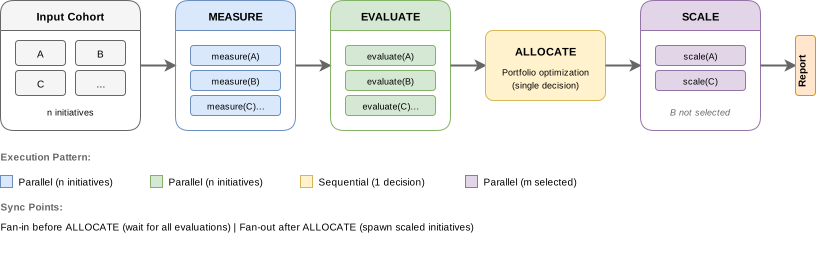
Synchronization Points
Point |
Trigger |
Action |
|---|---|---|
After MEASURE |
All initiatives measured |
Collect results → EVALUATE |
After EVALUATE |
All initiatives evaluated |
Collect results → ALLOCATE |
After ALLOCATE |
Portfolio selected |
Fan-out to SCALE |
After SCALE |
All scaled initiatives complete |
Generate Outcome Report |
Handler Interface
Each component processes a single initiative and returns a single result. Parallelism is handled by the orchestrator, not the handlers. Components are selected via YAML stage configs and constructed by the component registry — no Python edits needed to swap implementations.
Exception: ALLOCATE is a fan-in component — it receives all evaluated initiatives as a batch (
{"initiatives": [...], "budget": ...}) and returns a single portfolio selection. This is inherent to the allocation problem: you can’t select a portfolio by looking at initiatives one at a time.
def handler(event: dict, context=None) -> dict:
    """Lambda-compatible interface for a single initiative."""
    # Process one initiative
    return result
Deployment Strategy
Environment |
Orchestration |
Parallelism |
|---|---|---|
Local Dev |
Python script |
|
AWS Production |
Step Functions |
|
The handler interface is identical in both environments.