Decision Loop
Businesses face countless decisions with incomplete information. Which initiatives will move the needle? Where should resources go?
Economic thinking provides rigor for decision-making. First, measure impact—use causal inference to establish what is true. Then, evaluate the evidence—assess how reliable each estimate is based on methodology rigor and research design. Then, allocate resources—use decision theory to determine what to do. Done well, measurement, evaluation, and allocation create a learning loop: each action produces new evidence, which updates beliefs and informs the next allocation.
Software engineering enables implementation. The Impact Engine — an open-source Python ecosystem built alongside this material — provides the tools to measure impact, evaluate evidence, and allocate resources systematically. It turns economic thinking into a scalable, repeatable pipeline rather than one-off analyses.
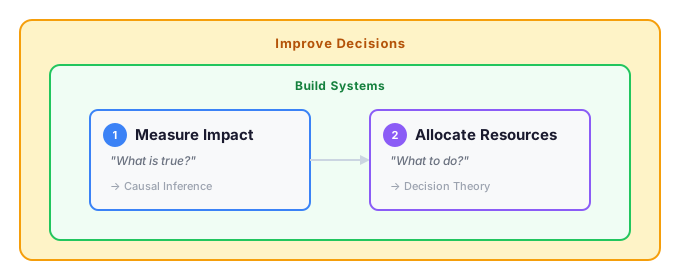
Framework
Measure Impact. What is true? Before allocating resources, you must understand what actually works. This stage teaches causal inference methods—from randomized experiments to observational techniques—that distinguish correlation from causation and establish genuine cause and effect.
Evaluate Evidence. How much should we trust this? Not all measurements are equally reliable. This stage teaches how to assess the quality of causal evidence—examining methodology rigor, identification assumptions, and the strength of the research design—to determine which estimates are trustworthy enough to act on.
Allocate Resources. What should we do? Knowing what works is not enough—you must decide where to invest under constraints and uncertainty. This stage teaches how to allocate resources across initiatives based on measured impact and remaining uncertainty. Better evidence enables better bets.
Build Systems. How do we make this repeatable? Measurement and allocation only matter if they can be executed reliably. This stage teaches software development practices—version control, testing, deployment—that turn methods into durable systems for repeated measurement and decision-making.
Improve Decisions. How does this change outcomes? Evidence, priorities, and systems only matter if they shape real behavior. This stage teaches how to translate insights into decisions that are actually implemented. The goal is not economic thinking or tools in isolation—it is driving sustained business outcomes.
You will learn to build and operate 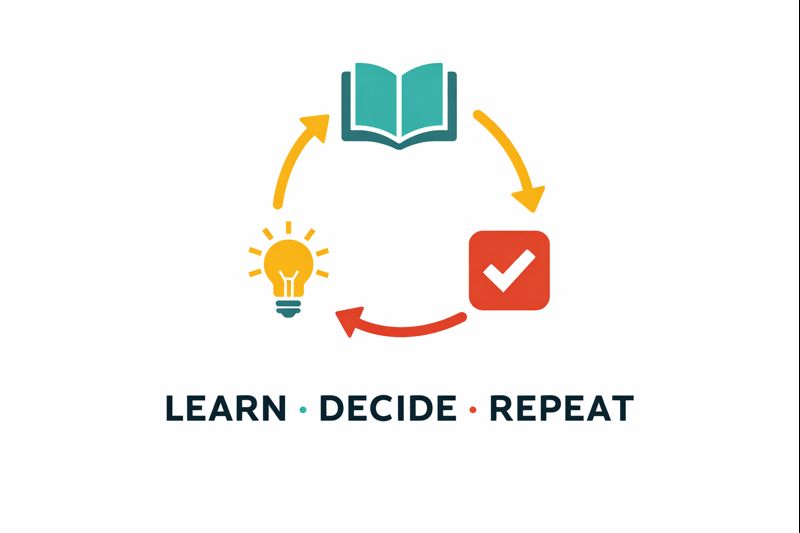 Learn · Decide · Repeat systems — combining causal inference, evidence evaluation, decision theory, software engineering, and implementation strategies to turn analysis into systematically improved decisions.
Throughout the material, we ground these ideas in a single, concrete decision context drawn from large-scale online retail. The problem of improving product data quality at scale provides the domain in which every method, system, and decision is introduced.